Publication
Kexin Wang, Yitong Sun, Ticha Sethapakdi, Tianyu Yu, Yixin Wang and Stefanie Mueller.
!nteractivesPub: Redistributing Author and Reader Effort through Interactive Academic Authoring
In Proceedings of the Extended Abstracts of the 2026 CHI Conference on Human Factors in Computing Systems (CHI EA '26).
DOI PDF Demo
!nteractivesPub: Redistributing Author and Reader Effort through Interactive Academic Authoring
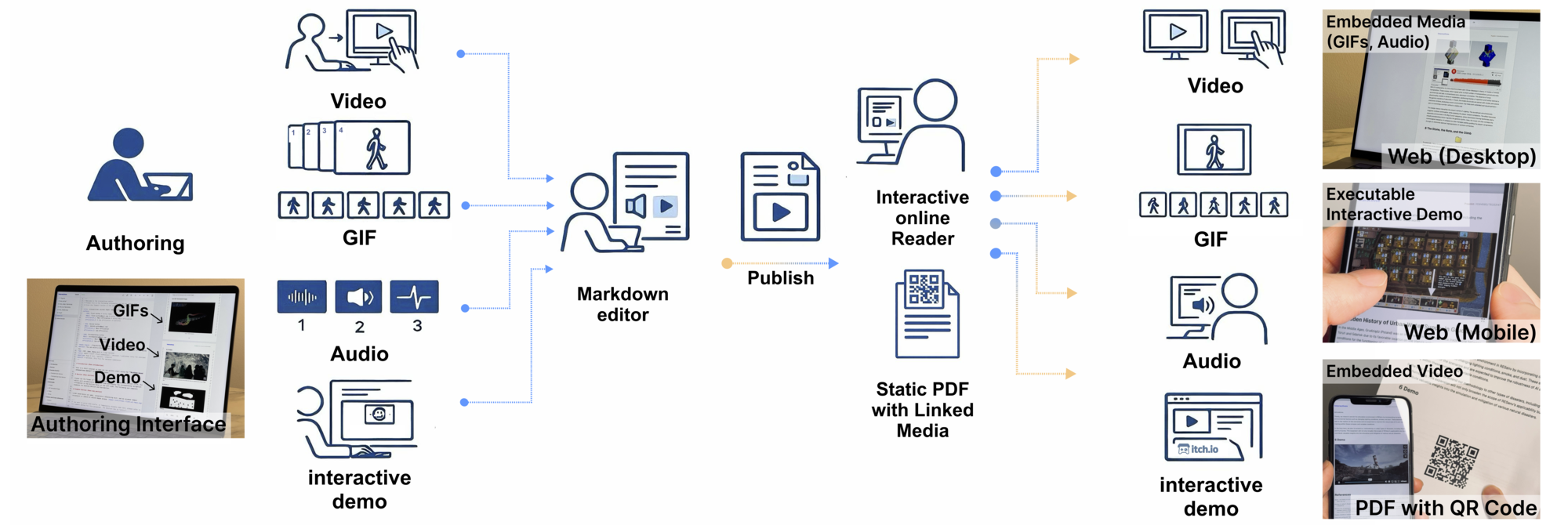
Academic writing still predominantly relies on text and static images, which limits the effective communication of dynamic and process-oriented research. We present !nteractivesPub, an accessible authoring and publishing workflow that enables authors to embed multimedia assets and interactive components directly into academic manuscripts, while remaining compatible with existing publication formats. The system addresses the high effort required to integrate interactivity, the fragmentation of interactive artifacts across external platforms, and their misalignment with established scholarly workflows. Through a field deployment and two user studies, we found that reading interactive content is associated with higher perceived comprehension and broader content exploration, while authoring interactive content is associated with lower reported expressive effort. This work frames interactivity as an expressive resource in scholarly communication, suggesting its potential to redistribute expressive and interpretive effort across authors and readers and to support the institutional adoption of interactive academic publishing.
INTRODUCTION
In practice-oriented fields such as human–computer interaction and computer graphics, many reported phenomena are inherently dynamic: systems respond to input, workflows unfold over time, and outcomes vary with parameters or states. Prior work has recognized the mismatch between such phenomena and static papers, exploring technical approaches including animations and interactive visualizations. Empirical studies further suggest that interactive elements can facilitate comprehension of dynamic processes.
Despite this potential, incorporating multimedia or interactive components into academic writing remains costly due to friction with peer review, archival formats, and incentive structures. Moreover, interactive components have rarely been examined as a cognitive expressive resource for reducing both readers’ comprehension burden and authors’ expressive effort, particularly for audiences without strong technical backgrounds. As a result, the broader value of interactive expression for knowledge transfer, teaching, and practice remains underexplored.
To investigate this gap, we developed !nteractivesPub, an accessible authoring and publishing workflow which not only lets authors embed externally hosted multimedia, such as videos, audio clips, or interactive artifacts, directly into the main narrative, but also provides readers an interactive view, where those dynamic components run in place (Figure 1). To remain compatible with review and long-term archiving, the same manuscript can also be exported as a conventional PDF that preserves continuity by linking interactive units via scannable references. Importantly, embedding these units requires no programming, minimizing implementation overhead for authors.
We provide preliminary evidence from two user studies that evaluate !nteractivesPub from both the reader and author perspectives. A between-subjects reading study compares an interactive article with a matched static PDF, and a within-subjects authoring study compares our interactive workflow with a traditional writing workflow; results indicate that in-situ interaction is associated with improved perceived comprehension and broader exploration during reading, and with reduced perceived expressive effort and workload during authoring.
Our contributions include:
- A workflow: an end-to-end authoring and reading loop that supports embedding multimedia and executable interactive units.
- Empirical evidence: the effects of interactive reading and interactive authoring on understanding and exploration, and on expressive effort and workload.
- A framing: treating interactivity as an expressive resource in scholarly communication, particularly for dynamic, process-oriented, and experiential content.
RELATED WORK
Media Tension in Scholarly Communication
A line of work in HCI has explored enhanced scholarly formats, repeatedly finding that adoption is limited less by technical feasibility than by constraints of review, archiving, and incentives. Your Paper is Dead! discussed opportunities and barriers for embedding animated figures, noting that academic writing remains constrained by print-centric review and publication processes [3]. Distill’s editors further emphasized the need to align enhanced formats with existing incentive structures [6]. Living Papers compiles one manuscript into PDF, interactive web articles, and extractable APIs, while Chameleon augments existing PDFs and slide decks via dynamic overlays; both foreground compatibility with review and archival workflows rather than technical feasibility alone [5, 9]. In practice, ACM venues such as CHI have pursued format-level modernization via the TAPS production workflow, which generates both a publication-ready PDF and an ACM-hosted HTML version from author-submitted sources [1]. However, the generated HTML largely remains a static rendering, and production often adds proofing and conversion overhead for authors, yielding limited payoff for interactive scholarly expression. This cost-benefit imbalance can dampen broader momentum for publication modernization, motivating workflows that deliver tangible gains in either authoring effort or reader understanding.
Cognitive Benefits of Interactive Expression and Gaps in Prior Work
Multimedia learning theory suggests that well-designed manipulable representations offload reasoning, state tracking, and causal inference to the environment, reducing the mental simulation burden of static text and images [10, 11, 12]. Empirical studies support this claim in specific contexts. For example, Augmented Math and Augmented Physics both demonstrated that transforming static textbook diagrams into interactive simulations can improve learners’ understanding of abstract concepts [4, 2]. Similarly, work published in Distill argues that multiple representations and active reading can support comprehension of complex models [6].
However, current discussions of enhanced papers largely remain at the level of technical feasibility and perceived or intuitive benefits. Far less attention has been paid to interaction as a cognitive expressive resource, particularly with respect to its role in both authoring and reading processes. If interactive components could be systematically characterized in this way, they may not only benefit academic authors and readers, but also reduce the implicit reliance of understanding on domain background and prior reading experience. This, in turn, could increase the transferability of knowledge across audiences and usage contexts, enabling reuse in teaching, industrial practice, and other dissemination media.
Fragmentation: Authoring and Reading Barriers
Despite increasing experimentation with interactive texts, scholarly communication remains fragmented across PDFs, videos, demos, and code repositories. Authors often bear additional technical and maintenance burdens, while readers must navigate multiple formats; non-technical readers face especially high barriers. Existing approaches address this fragmentation only partially. Your Paper is Dead! focuses on animated figures, Distill integrates interactive visualizations [6], and although venues such as JOSS recognize software as scholarship, system behavior is typically presented via external repositories [8]. While Living Papers supports multi-format output, it centers on an integrated executable/reactive document model [5]. Overall, current toolchains lack low-friction support for integrating interaction into everyday scholarly writing and for evaluating both author burden and reader understanding. We therefore examine whether a low-friction authoring workflow can make embedded interaction usable in everyday scholarly writing, and whether in-situ engagement supports readers’ comprehension and exploration while reducing authors’ expressive effort.
SYSTEM ARCHITECTURE AND IMPLEMENTATION
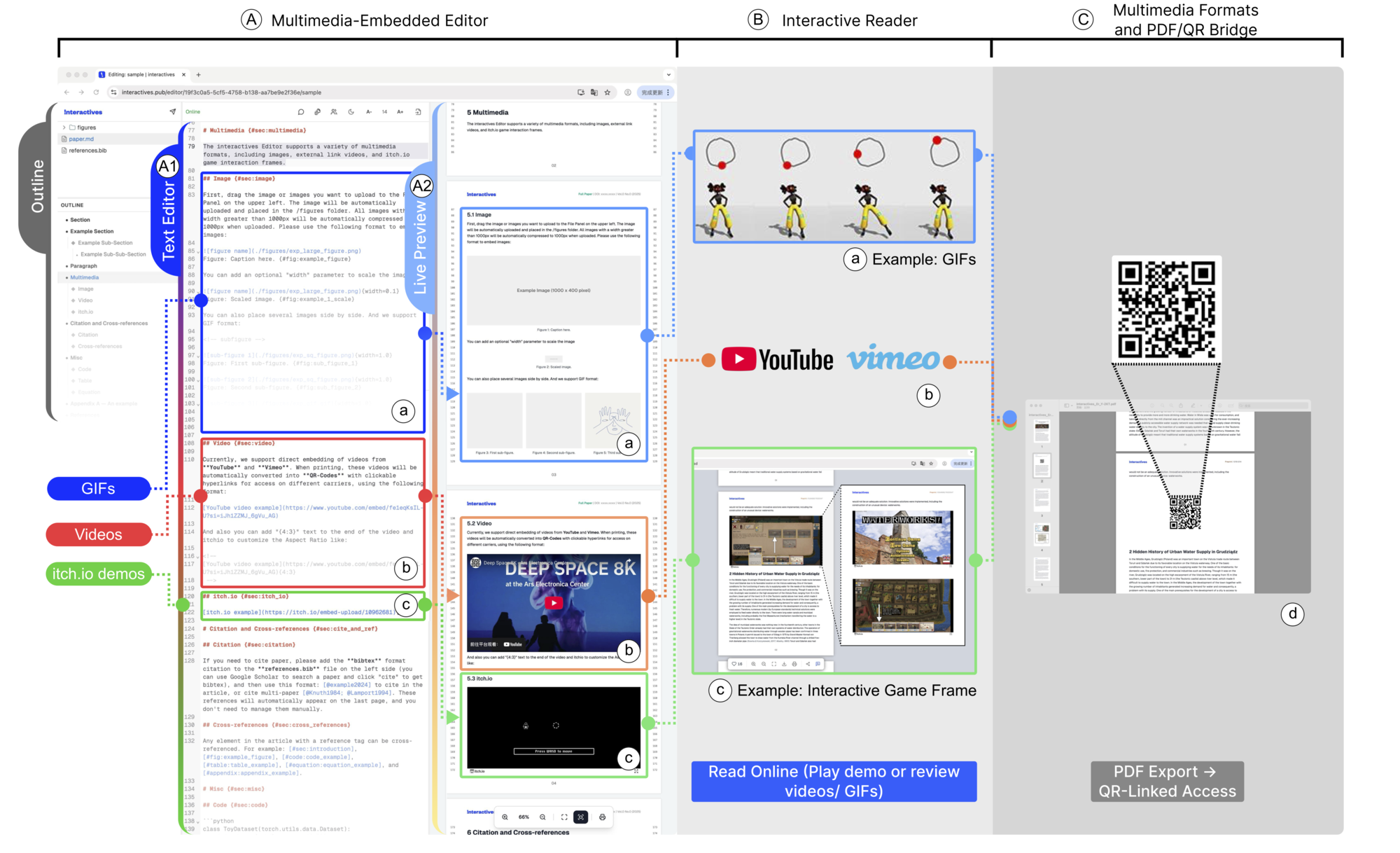
Based on the above analysis, we implemented a web-based interactive authoring and compilation editor, !nteractivesPub (a live demo is available; readers can register to edit and export their own interactive papers), designed to remain compatible with existing academic writing and publication workflows while reducing the cost of embedding multimedia and interactive content, and to enable systematic exploration of interaction as a cognitive expressive resource. The system follows an authoring paradigm similar to that of collaborative LaTeX editors such as Overleaf, allowing authors to work within a familiar writing model while extending traditional workflows to natively support embedded multimedia and interactive components.
Multimedia-Embedded Collaborative Editor
The authoring tool is a customized web-based collaborative editor implemented with a lightweight Markdown-based format to reduce the friction of embedding multimedia and interactive content (Figure 2, A1), while remaining compatible with established academic writing practices (e.g., equations in standard TeX syntax, tables, and code blocks). During rendering, embedded multimedia and interactive elements such as videos, animated GIFs, audio clips, or externally hosted interactive demos (e.g., from platforms like Itch.io) are rendered directly within the editor’s live preview (Figure 2, A2), allowing authors to verify interactive components in context. To maintain responsive interaction even for media-rich manuscripts, the editor updates layout and pagination incrementally during editing to provide near-instant visual feedback. For exporting, we implemented a custom Markdown-to-PDF pipeline that preserves academic layout conventions while replacing dynamic elements with scannable QR codes in the generated PDF, enabling readers of printed or static versions to access the corresponding interactive materials (Figure 2, C). This design preserves continuity between static and interactive representations across authoring, reading, and archival contexts.
Interactive Reader
The reading interface reproduces the paper’s original layout in HTML and CSS while seamlessly enhancing it with embedded multimedia components. Videos play inline, animated figures are interactive, and executable demos such as embedded simulations or small games run natively within the article view (Figure 2, B). Readers can directly interact with these elements to deepen their understanding and engagement. For archiving and offline access, readers could download the PDF version and scan the automatically-converted QR codes to access those dynamic assets, e.g., videos or interactive games.
PRELIMINARY EVALUATION
We conducted two complementary user studies to examine whether !nteractivesPub is associated with higher perceived comprehension during reading and lower reported writing pressure during authoring.
Reading Comprehension Study
We conducted a between-subjects study comparing an interactive article format with a static PDF in terms of readers’ perceived comprehension and exploration breadth. Sixteen adults were recruited online and balanced across conditions by self-reported technical/computational experience, then randomly assigned to either (1) an !nteractivesPub article with embedded videos and executable demos (e.g., Itch.io artifacts) or (2) a PDF with identical text and figures; videos and executable demos were referenced via links/QR codes and opened externally rather than embedded inline. The remote, browser-based study logged scrolling, navigation, and interaction events. After reading, participants completed a perceived-comprehension questionnaire; sessions lasted about 25 minutes on average.
Measures. We report two primary measures. Perceived comprehension was assessed using three five-point Likert items adapted with minimal contextualization from the validated C.R.E.A.T.E. survey’s "Decoding Primary Literature" factor [7], which captures respondents’ perceived difficulty and intimidation when interpreting scientific journal articles. The items included: (1) "The scientific literature (i.e., this paper) is difficult to understand." (reverse-coded), (2) "When I see scientific journal articles, it looks like an unfamiliar language to me." (reverse-coded), and (3) "I am not intimidated by the scientific language in journal articles." Responses were averaged after reverse-coding, such that higher values indicate higher perceived comprehension. Content access diversity captured exploration breadth behaviorally from interaction logs. It was defined over a fixed set of three content types available in the article materials in both conditions (inline in Interactive; via external links/QR codes in Static): (1) core narrative content (text and figures), (2) video demonstrations, and (3) executable demos. A content type was counted as accessed if the participant generated at least one corresponding interaction event during the session. Content access diversity was computed as the number of distinct content types accessed divided by three, resulting in a value in $[0,1]$.
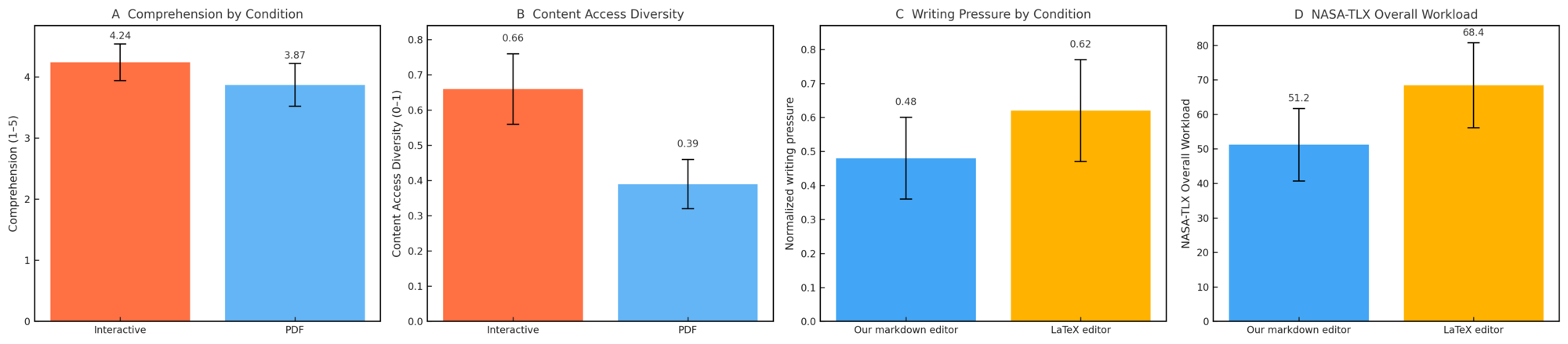
Results. Figure 3 summarizes the main findings. Between-condition differences were tested using two-tailed independent-samples tests (Welch’s $t$ when variance assumptions may differ). We report Hedges’ $g$ for mean differences and Cohen’s $h$ for bounded proportion-like metrics; associations are reported with Pearson’s $r$. Readers in the Interactive condition reported higher perceived comprehension than readers in the Static condition (M = 4.24, SD = 0.50 vs. M = 3.87, SD = 0.60, Welch’s $t$-test, $p < .05$, Hedges’ $g = 0.63$). Content access diversity was also higher in the Interactive condition (M = 0.66 vs. M = 0.39, $p < .01$, Cohen’s $h = 0.55$). Within the Interactive condition, perceived comprehension was positively correlated with content access diversity (Pearson’s $r \approx .40$, $p < .05$).
Writing Pressure
We examined whether interactive authoring reduces writing pressure relative to a static workflow. Sixteen additional participants with HCI and new media arts backgrounds completed two short authoring tasks under two conditions: Interactive (our Markdown-based editor) and Static (a LaTeX-like text editor). Tasks involved describing (1) emergent behavior in a generative particle system and (2) mechanics of a gesture-based game, chosen to impose distinct constraints (spatial/algorithmic vs. temporal/interactive reasoning). To avoid confounding writing pressure with media production, participants were provided with the same pre-prepared artifact pack for each task (e.g., online executable demo URLs, images, and/or videos) and were instructed to embed and annotate these materials rather than create interactive artifacts from scratch. Both conditions therefore required producing the same narrative deliverable; only the authoring workflow/tool differed. Condition and task order were counterbalanced using a $2 \times 2$ Latin square to mitigate fatigue effects. The lab study logged timestamped interaction events during each trial.
Measures. We report two primary measures. Writing Pressure was operationalized as a per-trial composite index that integrates subjective tension and behavioral strain during authoring. Here, a trial refers to one task completed under one tool condition. Immediately after each trial, participants completed the Pressure/Tension subscale of the Intrinsic Motivation Inventory (IMI) on a seven-point scale, yielding a subjective pressure score $S_i$ for trial $i$ (two calmness items were reverse-coded following standard IMI scoring). In parallel, we derived a behavioral strain score $B_i$ from interaction logs, including active authoring time, editing operations (insertions/deletions), revision intensity (deletion-to-insertion ratio), and preview/compile (or equivalent) actions indicating iterative checking. Because $B_i$ is computed solely from in-editor interaction logs, it captures authoring and embedding effort during the trial and excludes any off-editor artifact production time. We log-transformed skewed features, z-standardized within participant, and averaged standardized features to compute $B_i$. We then min–max normalized $S_i$ and $B_i$ across trials to $S'_i,B'_i \in [0,1]$ and defined trial-level writing pressure as $WP_i=(S'_i+B'_i)/2$. Condition-level Writing Pressure was computed by averaging $WP_i$ over the two trials within each condition (lower value indicates lower pressure). Full item wording and feature preprocessing details are provided in the supplementary materials. Overall workload was measured after each condition using the NASA–TLX questionnaire, using the six standard subscales to compute a 0–100 overall score.
Results. As shown in Figure 3, participants reported lower Writing Pressure in the Interactive condition than in the Static condition (M = 0.48, SD = 0.12 vs. M = 0.62, SD = 0.15, repeated-measures ANOVA, $F(1,15) \approx 8.5$, $p < .01$, partial $\eta_p^2 = 0.36$), corresponding to an approximate 22% reduction in expressive strain. NASA–TLX scores showed a similar trend: overall workload decreased from M = 68.4 (SD = 12.3) in the Static condition to M = 51.2 (SD = 10.5) in the Interactive condition, with the largest reductions observed in Effort (75.4 to 55.2) and Frustration (68.1 to 32.5). Across participants, Writing Pressure was moderately correlated with the NASA–TLX Effort subscale (Pearson’s $r \approx 0.51$, $p < .01$), supporting its interpretation as a proxy for writing pressure.
DISCUSSION AND FUTURE WORK
Compared with static workflows, our preliminary findings suggest that !nteractivesPub is associated with lower reported writing pressure and higher perceived comprehension during reading. Interactive components enable in-place demonstration and on-demand inspection of system behavior, reducing reliance on exhaustive textual explanation and improving intuitiveness and accessibility for non-technical readers. Future work will include larger-scale longitudinal studies to assess robustness and the effects of authoring friction and workflow compatibility, as well as extensions toward an open, modular ecosystem with customizable interaction templates, collaborative authoring, and distributed hosting.
REFERENCES
- Association for Computing Machinery. 2022. TAPS Workflow. ACM Author Gateway. https://authors.acm.org/proceedings/production-information/taps-production-workflow Published March 2022. Accessed: 2026-01-21.
- Neil Chulpongsatorn, Mille Skovhus Lunding, Nishan Soni, and Ryo Suzuki. 2023. Augmented Math: Authoring AR-Based Explorable Explanations by Augmenting Static Math Textbooks. In Proceedings of the 36th Annual ACM Symposium on User Interface Software and Technology. 1–16.
- Tovi Grossman, Fanny Chevalier, and Rubaiat Habib Kazi. 2015. Your Paper is Dead! Bringing Life to Research Articles with Animated Figures. In Proceedings of the 33rd Annual ACM Conference Extended Abstracts on Human Factors in Computing Systems. 461–475.
- Aditya Gunturu, Yi Wen, Nandi Zhang, Jarin Thundathil, Rubaiat Habib Kazi, and Ryo Suzuki. 2024. Augmented Physics: Creating Interactive and Embedded Physics Simulations from Static Textbook Diagrams. In Proceedings of the 37th Annual ACM Symposium on User Interface Software and Technology. 1–12.
- Jeffrey Heer, Matthew Conlen, Vishal Devireddy, Tu Nguyen, and Joshua Horowitz. 2023. Living Papers: A Language Toolkit for Augmented Scholarly Communication. In Proceedings of the 36th Annual ACM Symposium on User Interface Software and Technology. 1–13.
- Fred Hohman, Matthew Conlen, Jeffrey Heer, and Duen Horng Polo Chau. 2020. Communicating with Interactive Articles. Distill 5, 9 (2020), e28.
- Sally G. Hoskins, David Lopatto, and Leslie M. Stevens. 2011. The CREATE Approach to Primary Literature Shifts Undergraduates’ Self-Assessed Ability to Read and Analyze Journal Articles, Attitudes about Science, and Epistemological Beliefs. CBE—Life Sciences Education 10, 4 (2011), 368–378.
- Daniel S. Katz, Kyle E. Niemeyer, and Arfon M. Smith. 2018. Publish Your Software: Introducing the Journal of Open Source Software (JOSS). Computing in Science & Engineering 20, 3 (2018), 84–88.
- Damien Masson, Sylvain Malacria, Edward Lank, and Géry Casiez. 2020. Chameleon: Bringing Interactivity to Static Digital Documents. In Proceedings of the 2020 CHI Conference on Human Factors in Computing Systems. 1–13.
- Richard E. Mayer. 2014. Incorporating Motivation into Multimedia Learning. Learning and Instruction 29 (2014), 171–173.
- Evan F. Risko and Sam J. Gilbert. 2016. Cognitive Offloading. Trends in Cognitive Sciences 20, 9 (2016), 676–688.
- Bret Victor. 2011. Explorable Explanations. https://worrydream.com/ExplorableExplanations/ Accessed: 2026-01-19.